The Ultimate Guide to Kitesurf Downwinds in Brazil (2026)
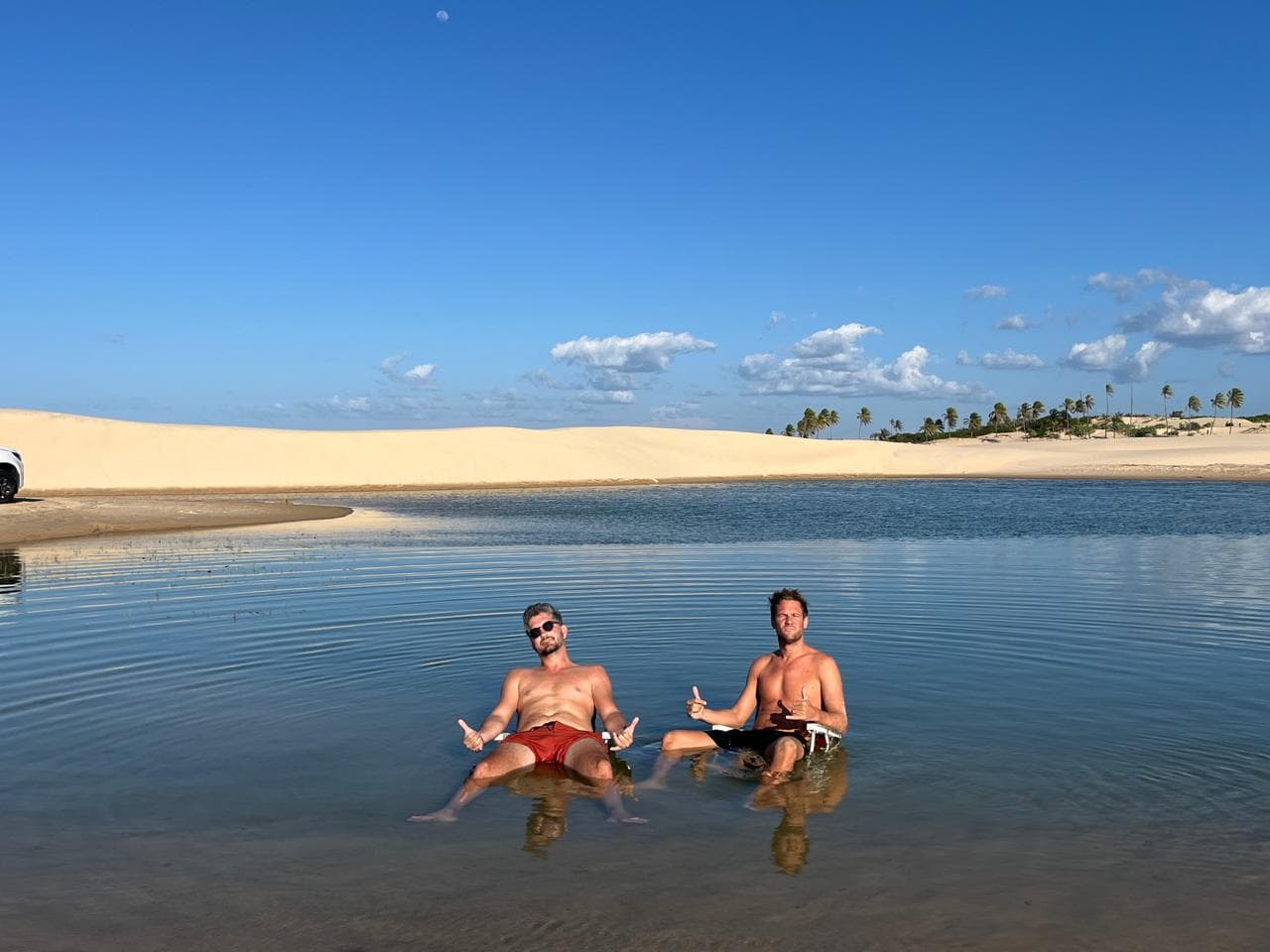
Northeast Brazil is the place where kitesurf downwinds stopped being an adventure for a handful of locals and became a trip people plan a year ahead. Between Cumbuco, near Fortaleza, and Atins, at the edge of the Lençóis Maranhenses, roughly 600 km of open beach face a trade wind that blows side-onshore for months at a time. You launch in one village, ride with the wind at your back, and land in the next one.
We live on this coast and guide downwinds on it every season, from Jericoacoara. This guide puts in one place what we explain to our guests before they book: why Brazil works so well, when to come, which spots to know, which route fits which level, what to pack, how to get around, and how to stay safe on a coast that is beautiful precisely because it is remote.
It is written for riders planning their first downwind in Brazil as much as for those coming back for a longer route. Read it in one go, or jump to the section you need.
Why Brazil is the downwind capital of the world
Three things make this coast unique, and you rarely find all three in the same place.
The first is the wind. A steady southeast trade wind blows over the Atlantic all year, and from June to January it is reinforced every afternoon by a thermal effect: the sun heats the interior and pulls more air in from the ocean. Two wind systems stacked on top of each other give sessions that start late morning and run until sunset, day after day. In the core season you can plan a multi-day trip months in advance and reasonably expect to ride every day.
The second is the shape of the coast. From Fortaleza westwards, the shoreline runs almost in the same direction as the wind. That means the wind blows side-onshore: slightly towards the beach, never away from it. If anything goes wrong, the wind brings you back to the sand instead of pushing you out to sea. For a discipline where you cover dozens of kilometres in a day, that single detail is what makes long downwinds both possible and reasonably safe.
The third is what you ride past. Dunes that drop straight into the sea, freshwater lagoons behind the beach, river mouths, fishing villages where the day's catch is landed by hand, and finally the white dunes of the Lençóis Maranhenses. Warm water all season, no wetsuit, and long stretches where the only other people you will see are fishermen.
Add to that a chain of villages spaced at a comfortable riding distance from one another, each with pousadas and somewhere to eat, and you have a coast that seems designed for travelling by kite.
What a kitesurf downwind is, and how a guided one works
A downwind, or downwinder, is a one-way ride. Instead of riding back and forth in front of the same beach, you start in one place and finish in another, further down the wind. On this coast a day usually covers between 20 and 55 km, broken up by stops on the beach to rest, drink and eat something.
The obvious problem is everything that does not fit on your back: your bag, your second kite, water, spares, and a way home if the wind drops. That is what a support vehicle is for. On our trips a buggy or a 4x4 with a driver follows the group along the beach or the sand tracks, carries the luggage and the gear, and meets the riders at each stop.
On the water, a guide rides with the group. The guide chooses the line, decides where to stop, watches the tides and the river mouths, and adapts the pace to the slowest rider. Before each session there is a briefing on the day's route and conditions, and after it a short debrief.
At the end of the day you land in a new village, the car brings your bags to the pousada, and the next morning you start again. On a multi-day trip that is the whole rhythm: ride, land, eat, sleep, repeat, with the coast changing a little more every day.
If you want the full picture of what a downwind involves before reading on, our article on what a kitesurf downwinder is covers the basics in more detail.
Seasons and wind: when to go
The kite season on the Ceará, Piauí and Maranhão coast runs from June to January. Across that window the wind is reliable, usually between 18 and 25 knots.
September, October and November are the peak. Afternoons regularly reach 22 to 30 knots or more. This is the best time for long, fast downwinds and for experienced riders, and also the busiest time in Jericoacoara and Cumbuco. These months fill up first, so plan four to six months ahead.
June, July, December and January sit on either side of the peak. The wind is still strong and steady, just without the stronger gusts. These months suit riders doing their first downwind, lighter riders, and anyone who prefers powerful but comfortable conditions, often with fewer people on the beach.
February to April is the off-season. The wind becomes weaker and less regular, and rain is more frequent. We do not recommend building a downwind trip around these months.
The season is the same along the whole coast, from Cumbuco to Atins. What changes from one end to the other is not the wind calendar but the terrain, so choose your stretch of coast for the kind of riding you want, and your month for the strength of wind you like. Our season-by-season article goes into more detail month by month.
The spots, from Cumbuco to Atins
A downwind is a journey through places, and each one has its own character. Here are the six names you will hear most often, in the order you meet them riding with the wind, from east to west.
Cumbuco, Ceará. The best-known kite spot in Brazil, about 30 km and 40 minutes from Fortaleza airport. A long open beach with side-onshore wind, chop and small waves, plus the Cauípe lagoon a short ride downwind for flat water. Schools, shops and pousadas everywhere. It is the easiest place to land, test your gear and find your rhythm, and it is the starting point of the first half of our six-day route. All levels.
Preá, Ceará. A fishing village just upwind of Jericoacoara that has become the main kite beach of the area. The wind arrives clean off the ocean over a long, wide beach, with chop and small waves. Two of our one-day routes start here, Preá to Guriú (30 km) and Preá to Tatajuba (40 km). About 30 minutes by paved road from Jericoacoara airport. All levels.
Jericoacoara, Ceará. The most famous name on the coast: a former fishing village with sand streets, surrounded by dunes, with a sunset dune that fills up every evening. Most kiting happens at Preá, just upwind, and at the Guriú lagoon, just downwind, where beginners and advanced riders share flat water. Jericoacoara is the hinge of the whole coast, and every one of our routes passes through it. All levels.
Tatajuba, Ceará. A small village west of Jericoacoara, between high dunes and a lagoon, with a few pousadas and beach huts and not much else, which is exactly its charm. Flat water in the lagoon, small waves on the ocean side. It is the finish line of several one-day routes and of our two-day downwind, and the first stop on the longer routes heading west. From Jericoacoara it is about one hour by 4x4 or buggy along the beach, with a raft crossing at the Guriú river. All levels.
Barra Grande, Piauí. A kite village on the short coast of Piauí, quieter than Jericoacoara, still with the feel of a fishing community, and with enough bars and restaurants to celebrate the end of a big day. The 55 km leg into Barra Grande from Maceió is the longest of our three-day route, with flat sections and chop around the estuary. Nearest airport: Parnaíba. Intermediate level.
Atins, Maranhão. The end of the coast and of our longest route. A remote village of sand tracks at the mouth of the Preguiças river, with wide flat water at the river mouth and the dunes and lagoons of the Lençóis Maranhenses all around. Reaching Atins by kite, after days on the water, is one of the great moments of kitesurf travel. Intermediate to advanced level.
Between those six names are many others that our routes pass through: Paracuru, Guajiru, Icaraí de Amontada, Ilha do Guajiru, Barrinha, Guriú, Camocim, Maceió, Tutóia and Arpoador. Each one has its own page in our destinations section.
The classic routes and distances
The coast lends itself to routes of every length. These are the ones we run, from the shortest to the longest.
One day, 20 to 40 km. Four routes around Jericoacoara: Barrinha to Jericoacoara (20 km), Jericoacoara to Tatajuba (25 km), Preá to Guriú (30 km) and Preá to Tatajuba (40 km). Mostly flat water, a buggy following along the beach, pick-up at your hotel and back the same evening. This is the Downwinder Initiation, made for a first downwind or for riders who only have one free day.
Two days, about 45 km. Barrinha to Jericoacoara on day one, a night in Jericoacoara, then Jericoacoara to Tatajuba on day two. The gentlest way to find out what riding two days in a row feels like.
Three days, about 115 km. Jericoacoara to Tatajuba (25 km), Tatajuba to Maceió (35 km), then Maceió to Barra Grande (55 km), with nights in Tatajuba, Maceió and Barra Grande. You leave Jericoacoara and do not come back: this is where a downwind becomes a real journey. For most intermediate riders it is the best balance between adventure and effort.
Six days, about 300 km, in two versions. Route A goes from Cumbuco to Jericoacoara, through Paracuru, Guajiru, Icaraí de Amontada, Ilha do Guajiru and Preá. Route B goes from Jericoacoara to Atins, through Tatajuba, Maceió, Barra Grande, Tutóia and Arpoador, finishing along the Lençóis Maranhenses. Put the two together and you have the full Cumbuco to Atins coast, one of the great kitesurf journeys in the world. These routes are for experienced riders.
Tailor-made. If none of these fits your dates or your group, we build a route around the number of days you have, the riding you want and the level of each rider, anywhere between Cumbuco and Atins.
All our trips are private: only your group, from 1 to 6 riders, with your own guide and your own support vehicle.
What level do you need?
This is the question that matters most, and the one people are least honest about when booking. A downwind is not technically difficult, but it is long, and you cannot simply walk back to your car if you are tired.
For a one-day downwind, you need to be an independent rider: you can launch and land with help, ride in both directions, hold your line and stay upwind of a point. You do not need to jump or do tricks. The routes are short, the water is mostly flat and the buggy is never far away.
For the two and three-day routes, you should be able to ride comfortably upwind, handle a transition without losing much ground, ride for two to three hours with a few breaks, and above all run a self-rescue on your own if you have to.
For the six-day routes, technique matters less than endurance and self-sufficiency. You will ride several long days in a row, sometimes in stronger wind than you would choose, across water that changes from flat lagoons to chop and waves. You need to be comfortable overpowered, able to ride for hours, and calm if something does not go to plan.
Before choosing, ask yourself a few honest questions. Can I ride for three hours without being exhausted? Have I actually done a self-rescue in deep water, not just practised it in a lesson? Am I comfortable in 25 knots and more? Can I ride several days in a row? If you hesitate on one of them, take the shorter route. It is not a downgrade: it is the trip you will enjoy.
And if you are between two levels, tell us how you ride. Our guides adjust the pace within each trip, and our article comparing the intermediate and advanced routes can help you decide.
Gear: what to bring on a Brazil downwind
On a downwind you change village almost every day and the support vehicle has limited space, so the rule is simple: bring what you need, and nothing more.
Kites. With 18 to 25 knots on most days and more in the peak months, most riders use kites between 7 and 10 square metres, depending on their weight. Two sizes that overlap are better than one kite that does everything, because the wind can change during a single session. Tell us your weight when you book and we will suggest sizes.
Board. Bring the board you ride best on and are most comfortable with for several hours. A downwind is not the moment to try new gear. Many riders choose a twin-tip for the comfort and the easy transitions; others prefer a directional or a foil once they are experienced. Ask us before you bring a foil, because not every stretch suits it.
Harness. On a long day, the harness matters more than people think. Choose one that fits well and supports your lower back, ideally one you have already used for long sessions. Back pain after four hours on the water is the most common complaint we hear, and it almost always comes from a harness that is too soft, too loose or the wrong size.
Protection from the sun. You are close to the equator and on the water for hours. A long-sleeved lycra, a cap or hat that stays on, strong water-resistant sunscreen, lip balm and sunglasses with a strap are not optional.
Feet and the rest. Reef booties are useful on some beaches and river mouths. Add a small waterproof bag for your phone, a hydration pack or a water bottle you can carry, and quick-dry clothes for the evenings. No wetsuit: the water is warm all season.
Spares. Our support car carries the essentials: pumps, lines, repair kits and a few kites to borrow. You do not need to bring a second pump or a repair kit of your own. Our packing article includes a full checklist you can print.
Logistics: airports, transfers, accommodation and budget
The coast is long and the access points are spread out, so the logistics depend on where your route starts and ends.
Airports. Fortaleza (FOR) is the main international gateway, with direct flights from Europe and connections through São Paulo and other Brazilian cities. Jericoacoara airport (JJD), in Cruz, is about one hour from the village and receives domestic flights. For the end of the coast, Parnaíba (PHB) is the closest airport to Barra Grande, and São Luís (SLZ) is the gateway to Atins and the Lençóis Maranhenses.
Getting to the start. Cumbuco is about 40 minutes from Fortaleza airport. Jericoacoara is about 4.5 to 5 hours by road from Fortaleza, or one hour from Jericoacoara airport; the last stretch crosses sand and is done in a 4x4, and private cars stay in Jijoca. Our article on getting to Jericoacoara explains every option, and we can put you in touch with drivers we trust.
Getting home from the finish. From Barra Grande, the return goes through Parnaíba or back to Jericoacoara, about 3 hours by 4x4 along the coast. From Atins, you travel by boat or 4x4 to Barreirinhas, then about 4 hours by road to São Luís. Plan your flight home with this in mind and leave a margin.
Accommodation. On our multi-day trips you sleep in pousadas, simple and comfortable guesthouses run by local families, with breakfast included. In the smallest villages the choice is limited and comfort is basic, which is part of the experience.
Luggage. One board bag and one soft bag per rider is the right amount. Your luggage travels in the support vehicle from one village to the next, so you ride with only what you need for the day.
Money. The currency is the Brazilian real. Cards are accepted almost everywhere, even in small villages, but cash machines are rare outside the towns, so withdraw some reais in Fortaleza. Our trips can be paid in reais, euros or US dollars.
Budget. The price of a guided downwind depends on the length of the route, the number of riders sharing the guide and the vehicle, the time of the season and the type of accommodation. Our article on the cost of a kitesurf trip to Brazil gives real figures for each of our routes and lists what is and is not included.
Insurance. Travel insurance that explicitly covers kitesurfing is compulsory on all our trips. Many standard policies exclude it, so read the small print.
Safety on a downwind
The remoteness that makes this coast so beautiful also means help is further away than at your home spot. A downwind is safe when it is well prepared. These are the rules we follow on every trip.
Never ride alone. A downwind is done in a group, with someone who knows the coast. Our guide rides with the group on every leg, stays in sight, and knows where to stop and where to get out of the water if needed.
A vehicle on land. The support car follows the group and can pick up a rider at any stop if the wind drops, if gear breaks or if someone is tired. On our multi-day trips it carries a Starlink satellite connection, because phone signal comes and goes between villages.
Self-rescue. Every rider should be able to release the kite, wind in the lines and use the canopy to get back to shore on their own. We run a refresher with every group on the first day, in calm, shallow water.
Tides and river mouths. Several stretches of this coast are crossed by rivers and estuaries, where the current changes with the tide. The guide plans the legs so that river mouths are crossed at the right time and chooses the line. This is the main reason we advise against riding an unknown stretch of this coast without someone who knows it.
Wind and weather. The wind can strengthen during the afternoon. Rig for the strongest wind expected, not for the morning lull, and say so if you feel overpowered. A rider who stops and changes kite is never a problem; a rider who keeps going overpowered can become one.
Sun, water and fatigue. Dehydration and sunburn are the most common problems on a downwind, far ahead of accidents. Drink at every stop, eat something, cover up, and tell the guide if you are tired. Fatigue is when mistakes happen.
Briefing and communication. Before each session, the guide explains the route, the stops, the signals and what to do if you get separated. Agree on simple hand signals and respect them.
Guided or on your own?
Both are possible on this coast, but they are not the same trip.
On your own, you need to organise a vehicle and a driver who knows the sand tracks for every leg, book a different pousada every night in villages with patchy phone signal, read the tides and river mouths yourself, and handle every problem as it comes, often in Portuguese. For an experienced rider who speaks the language and has time to lose a day if something goes wrong, it is a real adventure and can cost less on paper.
With a guide, you ride the same wild coast, but someone who knows it rides with you, a vehicle carries your bags and comes to get you if needed, and the next night is already organised. You spend your evenings watching the sunset instead of looking for a driver for the next day.
For most riders, especially on a first downwind in Brazil or on a route with river mouths and remote stretches, a guided trip is the safer and more relaxed choice. Our article on guided and self-planned downwinds compares the two honestly.
How to plan your Brazil downwind, step by step
1. Choose your dates. June to January, with September to November for the strongest wind and June, July, December and January for more moderate wind.
2. Be honest about your level. One day if it is your first downwind, two or three days if you ride comfortably and can self-rescue, six days if you can ride for hours several days in a row.
3. Choose your stretch of coast. Around Jericoacoara for short routes and flat water, Jericoacoara to Barra Grande for a first real journey, Cumbuco to Jericoacoara or Jericoacoara to Atins for the big one.
4. Book your flights once the route is set, into Fortaleza or Jericoacoara for the start, and out of Fortaleza, Parnaíba or São Luís depending on where you finish.
5. Get your insurance, check the entry rules for your passport, and prepare your gear: two kites, your usual board, a harness that supports your back, and serious sun protection.
6. Write to us with your dates, your level and the number of riders. We will tell you honestly which route fits and send you a quote.
Frequently asked questions
From June to January. September to November bring the strongest wind, often 22 to 30 knots or more; June, July, December and January have steady wind of 18 to 25 knots. February to April is the off-season.
On the north-east coast, between Cumbuco and Atins, across the states of Ceará, Piauí and Maranhão. The best-known stretches are around Jericoacoara, from Jericoacoara to Barra Grande, and from Jericoacoara to Atins along the Lençóis Maranhenses.
For a one-day downwind, being an independent rider who can ride in both directions is enough. For multi-day routes, you need to ride upwind comfortably, ride for several hours and be able to self-rescue on your own.
About 600 km. We run it in two six-day halves of about 300 km each, split at Jericoacoara: Cumbuco to Jericoacoara, and Jericoacoara to Atins.
Most riders use kites between 7 and 10 square metres, depending on their weight. Bring two sizes that overlap rather than a single kite.